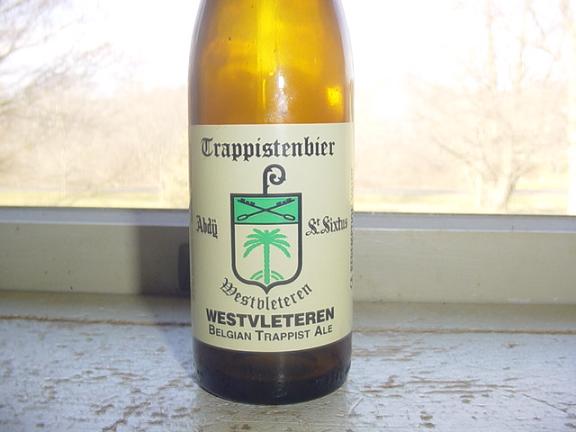
Anyone ever have one of these.
I have had it in the fridge for a while and deceided to taste it with a torano last night in the hot tub
very tasty stuff and veryyyyyyyyy strong
but at around 8 bucks a bottle not an every day drink
I picked 2 bottles up at a local store while they were doing tastings They said only about 20 cases had been imported to the US and they were lucky enought to get one case
TRAPPIST ALE
There are six Trappist breweries in the world, all in Belgium. They are Westmalle, Westvleteren, Chimay, Rochefort, Orval and Achel. No other breweries are entitled by law to apply that name to their product.
Between the six abbeys about 20 beers are brewed. All are top-fermenting, relatively to very strong, bottle conditioned ales.
Orval is the oldest of the brewing monasteries, founded in the 11th century by Benedictine monks. Interruptions to the monastic way of life (the French Revolution and the Napoleonic period) caused a religious exodus from France and the establishment of several Belgian abbeys in addition to those that already existed. Several of these abbeys typically began producing beer for internal use, then expanded to commercial production, selling first locally before making their beer available on a larger scale.
The term "trappist" fell into use in the years between WWI and WWII, popularized by Chimay (1850). It was there that Father Theodore and the famed brewing scientist Jean De Clerck developed much of the brewing theory that makes Trappist beers what they are.
ORVAL: The Notre-Dame d'Orval has a long history of distruction and reconstruction. The single beer they produce is probably the driest of the Trappist ales. They began brewing prior to the French Revolution, but that conflict was among the distructive events of the monestary's history.
CHIMAY: The most commercial of the Trappist brewing entities, this monestary has a history of taking beer production very seriously. After World War II the legendary brewing scientist Jean De Clerck was a major factor in re-establishing the brewery. Their 3 beers are available in a variety of sizes, including magnum bottles of Grand Reserve.
WESTMALLE: The orginator of the widely imitated triple style. The abbeys full name id Our Lady of the Sacred Heart. Founded in 1794 it began making beer in the early 19th century. Beer production became commercial in 1920.
WESTVLETEREN: The smallest producer of the brewing abbeys. Their beer is very expensive cause it you want it you have to go there - they don't ship! This is a rare example of a beer with both Trappist and abbey affiliations. St. Bernardus - formerly know as St. Sixtus - is made by a secular brewer under the licsence of the Abbey of St. Sixtus in the town of Westvleteren. Confusingly, the abbey of St. Sixtus makes the Westvleteren ales in a Trappist capacity, but not St. Sixtus ales!
ROCHEFORT: Actually known as Notre-Dame de Saint-Remy (located neat the southern town of Rochefort), this monestary began brewing in 1595 - that's quite a heritage! Their 3 beers are ale dark and fairly sweet ales.
ACHEL: This newest Trappist brewery resembles a brewpub. It has a cafeteria line where you get your food and beer and tables both inside and on the outdoor patio. Father Thomas of Westmalle started the brewery, the current brewer is Brother Jules. When Achel first became available the general buzz was that it was clearly the inferior Trappist ale. But it did not take long for that to change, favor for this one has been steadily increasing. Now-a-days there is no shortage of praise for Achel. It took even God more than one day to get it all right!
ABBEY ALES
Though only five Trappist breweries still exist in Belgium, the number used to be greater. The last to cease production was the Benedictine monastery at Affligem (during WWII). "Yeah, but I can still buy Affligem" you might say, and you'd be right. Their classic Doubles and Tripples are still made by the De Smedt brewery under license of Affligem. Abbey ale is a term associated with beer brewed by non-monastic types, frequently under such a license. These beers cannot be called "Trappist", but usually derive their name from a shrine or a church or some other religious icon. It is typical for abbey ale to mimmik the styles of Trappist beer. Doubles and triples, such as appear in Westmalle's line, are very popular. Some beers, like St. Bernardus, are more similar to the dark, profoundly powerful brews of Rochefort and Westvleteren.
Click to View Image85 View(s)