WASHINGTON - For 2,000 years Judas has been reviled for betraying Jesus. Now a newly translated ancient document seeks to tell his side of the story.
The "Gospel of Judas" tells a far different tale from the four gospels in the New Testament. It portrays Judas as a favored disciple who was given special knowledge by Jesus — and who turned him in at Jesus' request.
"You will be cursed by the other generations — and you will come to rule over them," Jesus tells Judas in the document made public Thursday.
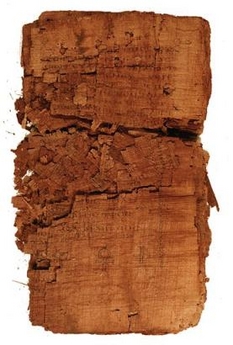
The text, one of several ancient documents found in the Egyptian desert in 1970, was preserved and translated by a team of scholars.
But it does show the diversity of beliefs in early Christianity, said Marvin Meyer, professor of Bible studies at Chapman University in Orange, Calif.
The text, in the Coptic language, was dated to about the year 300 and is a copy of an earlier Greek version.
A "Gospel of Judas" was first mentioned around A.D. 180 by Bishop Irenaeus of Lyon, in what is now France. The bishop denounced the manuscript as heresy because it differed from mainstream Christianity. The actual text had been thought lost until this discovery.
"Perhaps more now can be said," he commented. The document "implies that Judas only did what Jesus wanted him to do."
In a key passage Jesus tells Judas, "You will exceed all of them. For you will sacrifice the man that clothes me."
This indicates that Judas would help liberate the spiritual self by helping Jesus get rid of his physical flesh, the scholars said.
"Step away from the others and I shall tell you the mysteries of the kingdom," Jesus says to Judas, singling him out for special status. "Look, you have been told everything. Lift up your eyes and look at the cloud and the light within it and the stars surrounding it. The star that leads the way is your star."
The text ends with Judas turning Jesus over to the high priests and does not include any mention of the crucifixion or resurrection.
National Geographic said the author believed that Judas Iscariot alone understood the true significance of Jesus' teachings. The author of the text is not named in the writings.
Discovered in 1970, the papyrus was kept in a safety deposit box for several years and began to deteriorate before conservators restored it. More than 1,000 pieces had to be reassembled.
Click to View Image132 View(s)